Nizhoni Accelerated Academy
Staff Appreciation
NATIONAL CUSTODIAN DAY
FRIDAY, OCTOBER 2ND
Click to see NAA Staff Express Appreciation for Effie Banda

Nizhoni Accelerated Academy


Parent And Guardian Notices:
Climate & Culture Parent Survey:
CLICK HERE for the Climate & Culture Parent Survey
Positive Attendance Goals at Nizhoni Accelerated Academy:
CLICK HERE for Positive Attendance Goals at Nizhoni Accelerated Academy

September 22, 2026
Dear NAA Students, Parents, and Guardians,
I am proud of your successes daily, you are truly the best. Remember to give yourself a hug, celebrate your successes, and affirm your decisions every step of the way. Say your citizen of learning pledge every day, posted throughout our school, posted to our school website.
We enjoyed Parent and Teacher conferences, the PBIS Barbeque, Parent SITE Council Sign- up, and our cowboy-style team roping and music event along with presenters including John Hopkins University, truly amazing!
I am sending a letter with a basic plan for positve attendance along with a quick reference flyer for your cork board or postng on the refrigerator. The 40- and 100-Day count are important for school budget allocatons for the school year. We can work toward positve attendance goals every day.
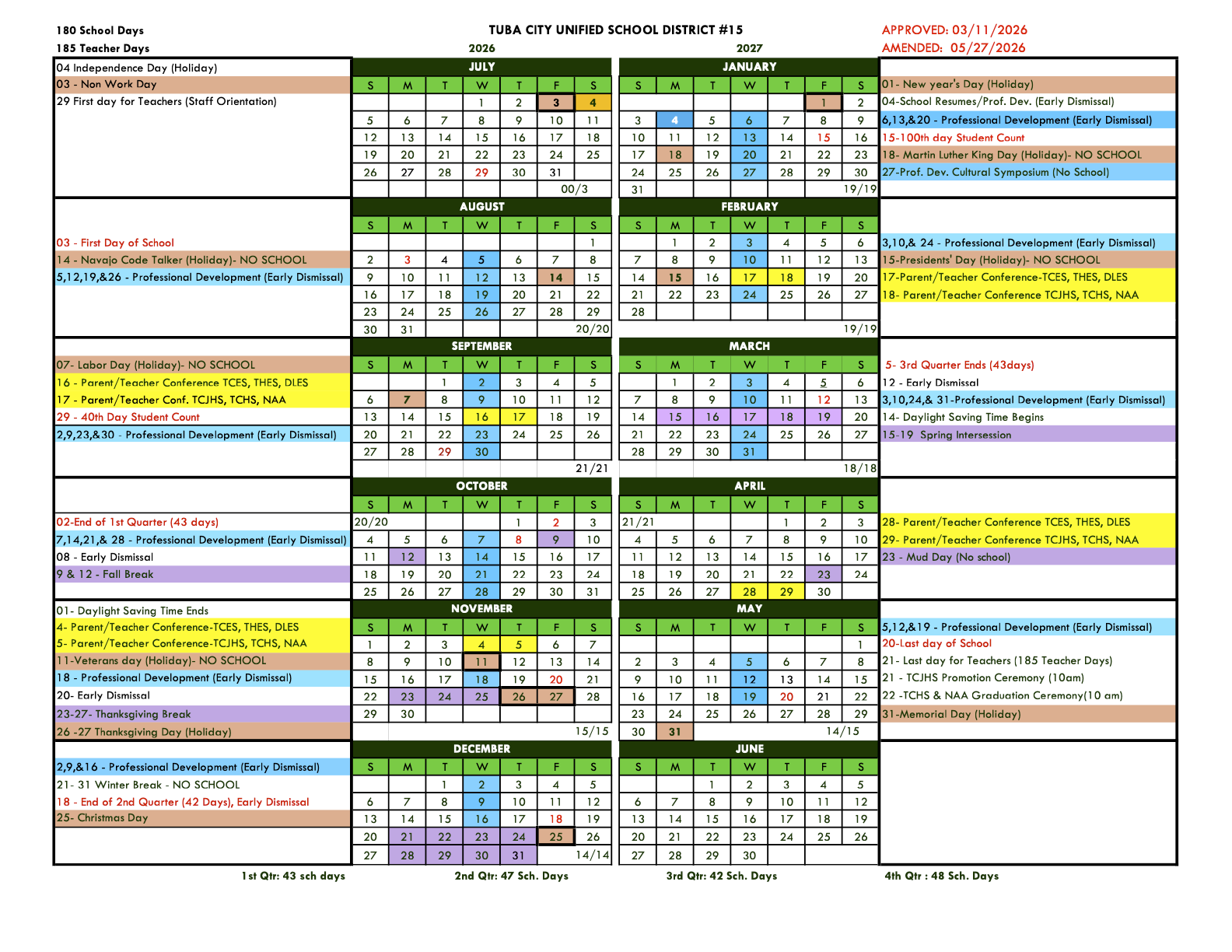
The checkpoints are: Tuesday, 9/29/2026, and Friday, 1/15/2027.
CLICK HERE for 40 & 100 Day Attendance Plan Flyer (PDF)
Michael S. Bilagody
Director
Nizhoni Accelerated Academy
Tuba City Unified School District #15
Students • Parents • Guardians | 2026–2027 School Year STRONGER TOGETHER
Major Attendance Checkpoints:
Tuesday, September 29, 2026 — 40-Day Count
Friday, January 15, 2027 — 100-Day Count
CLICK HERE to Download 40 & 100 Day Attendance Plan Timeline Chart (PDF)

NIGHT BEFORE: Check tomorrow's calendar → Check the weather → Prepare appropriate clothing → Pack backpack → Charge Chromebook → Pack charger → Set alarm → Go to sleep early enough to wake up rested.
MORNING: Wake up early rather than rushing → Check school/transportation messages → Dress for the weather → Eat a nutritious breakfast or school meal → Bring needed materials → Allow enough travel time → Arrive ready to learn.
Families can reinforce the routine with encouragement and help students plan ahead. The 40-Day and 100-Day Counts are checkpoints—not finish lines.
Consistent attendance matters throughout the school year.
ADE provides attendance, ADM and school-health guidance that schools and families can use to support this work. (ADE, School Finance; ADE, School Health Office Resources).
Arizona guidance recognizes circumstances involving adverse weather and conditions that may compromise safety within school attendance and instructional-calendar requirements. Families should therefore rely on official TCUSD #15/NAA communications when severe weather affects school operations rather than attempting unsafe travel.
CLICK HERE for Downloadable Weather Ready Attendance Plan (PDF)

Create a small PocketMod attendance and success planner with eight sections:
TODAY • TOMORROW • ASSIGNMENTS • APPOINTMENTS • ATTENDANCE GOAL • CREDITS/COURSES • IMPORTANT DATES • MY NEXT STEP
Put these two dates in bold:
SEPTEMBER 29, 2026 — 40-DAY COUNT
JANUARY 15, 2027 — 100-DAY COUNT
Students can add a daily PocketMod checklist:
Calendar • Weather • Transportation • Clothes • Backpack • Chromebook Charged • Alarm Set • Rest • Breakfast • Arrive on Time
PocketMod reference:
How to Make Anything. (2026, September 22). How to make a Pocketmod (2:41) [Video]. YouTube.
REST WELL → EAT WELL → PLAN AHEAD → CHECK THE WEATHER → ARRIVE READY → SHOW UP → KEEP GOING → GRADUATE
“Showing up is half the battle for success.”
40 DAYS STRONG → WEATHER READY → 100 DAYS STRONG → GRADUATION STRONG
You Belong Here. Together We Can! NAA — STRONGER TOGETHER
References and Resources:
Arizona Department of Education. Alternative Schools. Guidance regarding Arizona alternative-school eligibility, educational programming, accountability, and related student-support services.
Arizona Department of Education. Comprehensive School Wellness Program. Resources supporting healthy students, nutrition, wellness, supportive learning environments, and academic achievement.
Arizona Department of Education. Family and Community Engagement. Resources supporting reciprocal partnerships among families, communities, and schools.
Arizona Department of Education, Health and Nutrition Services. National School Lunch Program and School Breakfast Program. Arizona guidance regarding school nutrition programs, after-school snacks, Smart Snacks, wellness policies, food safety, and Child Nutrition Program requirements.
Substance Abuse and Mental Health Services Administration (SAMHSA). SAMHSA's Concept of Trauma and Guidance for a Trauma-Informed Approach. Framework identifying principles including safety; trustworthiness and transparency; peer support; collaboration and mutuality; empowerment, voice, and choice; and consideration of cultural and historical factors.
National Child Traumatic Stress Network (NCTSN). Trauma-Informed Schools for K–12. Resources addressing trauma-informed school systems and supportive environments for students, families, educators, administrators, and school communities.
Miller, Rick. Kids at Hope. TEDxHerndon. Presentation describing a strengths- and hope-oriented approach emphasizing belief in young people's capacity for success, caring adult relationships, and envisioning positive futures.
Video Resource (22 min. 25 sec.): Rick Miller, Kids at Hope | TEDxHerndon
Pantano High School, Vail School District. About PHS. Pantano's guiding principles include supporting the whole child emotionally, socially, and academically; individualized graduation planning; preparation for life after high school; development of life and job skills; and parent/community involvement.
(2026, September 22). How to make anything. How to make a Pocketmod (2:41) [Video]. YouTube.

October 15, 2026
3:15 PM - 5:15 PM in TCHS ROTC Room 511 for students interested in exploring medical careers and connecting with healthcare professionals. Click for details.

September 27, 2026
Click for a closer look and downloadable flyer (PDF).

September 24, 2026
Click for details and a downloadable flyer (PDF).

Free Application for Federal Student Aid (FAFSA)
FAFSA® Application | Federal Student Aid
Tuba City Chapter Scholarship Office
To'Nanees'Dizi (Tuba City)
Office of Navajo Nation and Financial Aid (ONNSFA)
Office of Navajo Nation Scholarship & Financial Assistance
Office of Hopi Financial Aid
Hopi Tribe Grants & Scholarships Program Applications - The Hopi Tribe
Northland Pioneer College
Automotive Technology | Northland Pioneer College, Arizona
Dine College
MyDineCollege | MyDinéCollege | MyDinéCollege
Coconino Community College
Coconino Community College - Start Small, Go Big
Navajo Technical University
NTU | Creating Leaders for Tomorrow
University of Arizona
University of Arizona in Tucson, AZ
Northern Arizona University
NAU | Bachelor's, Graduate, & Online Degrees
Arizona State University
How to Apply | Undergraduate Admissions | The University of Arizona Online
United States Naval Academy
USNA Home :: Leaders to Serve the Nation :: USNA
United States Air Force Academy
Home • United States Air Force Academy
United States Coast Guard Academy
USCGA - United States Coast Guard Academy
United States West Point Academy
United States Military Academy West Point
United States Air Force Academy
Space Force | U.S. Air Force Academy
United States Marine Corps
Recruitment
Marine Corps Recruiter
RSS Flagstaff
(928)502-9394
United States Coast Guard
Phoenix | United States Coast Guard
Navajo Department of Workforce Development
NDWD
The Hopi Tribe. Department of Education & Workforce Development
Department of Education & Work Force Development - The Hopi Tribe
Free Application for Federal Student Aid (FAFSA)
FAFSA® Application | Federal Student Aid
Tuba City Chapter Scholarship Office
To'Nanees'Dizi (Tuba City)
Office of Navajo Nation and Financial Aid (ONNSFA)
Office of Navajo Nation Scholarship & Financial Assistance
Office of Hopi Financial Aid
Hopi Tribe Grants & Scholarships Program Applications - The Hopi Tribe
Northland Pioneer College
Automotive Technology | Northland Pioneer College, Arizona
Dine College
MyDineCollege | MyDinéCollege | MyDinéCollege
Coconino Community College
Coconino Community College - Start Small, Go Big
Navajo Technical University
NTU | Creating Leaders for Tomorrow
University of Arizona
University of Arizona in Tucson, AZ
Northern Arizona University
NAU | Bachelor's, Graduate, & Online Degrees
Arizona State University
How to Apply | Undergraduate Admissions | The University of Arizona Online
United States Naval Academy
USNA Home :: Leaders to Serve the Nation :: USNA
United States Air Force Academy
Home • United States Air Force Academy
United States Coast Guard Academy
USCGA - United States Coast Guard Academy
United States West Point Academy
United States Military Academy West Point
United States Air Force Academy
Space Force | U.S. Air Force Academy
United States Marine Corps
Recruitment
Marine Corps Recruiter
RSS Flagstaff
(928)502-9394
United States Coast Guard
Phoenix | United States Coast Guard
Navajo Department of Workforce Development
NDWD
The Hopi Tribe. Department of Education & Workforce Development
Department of Education & Work Force Development - The Hopi Tribe
Thursday, November 5th
For NAA parents, guardians, and families.
October 7th, 8th, 14th, 21st, 28th
November 18th, 20th
December 2nd, 9th, 16th
Friday, October 9th - Monday, October 12th – Fall Break
Wednesday, November 11th – Veterans Day
Monday, November 23rd - Friday, November 27th – Thanksgiving Break
Standard Response Protocol
TCUSD has adopted Standard Response Protocol and
is training students & staff.
Operation: Reunification
Picking up students after incidents safely is the
Reunification Protocol families should know.
CLICK HERE for Parent/Guardian Handout (PDF)CLICK HERE for Video Overview